AURC Team 4
The team’s entry into the AURC 2024, aimed at upskilling team members following the departure of other experienced team members. The rocket gave invaluable experience to the team, building it up for future more ambitious projects that the team is working towards now.

Aerostructures
At the core of Zenith’s design philosophy are three pivotal state-points: achieving a target altitude above ground level (AGL), adhering to the payload mass constraints, and optimising the vehicle’s overall form factor. Zenith’s airframe is a testament to the team’s pursuit of aerodynamic optimisation whilst ensuring structural integrity. The airframe was designed to be as thin and light as possible, whilst being sufficiently strong to withstand the stresses of transonic flight. A majority of Zeniths airframe is manufactured from 1.5 mm thick Carbon Fibre Composite, with areas experiencing high bending stresses, such as the fuselage coupler, being 2 mm thick. Moreover, the rocket’s fins are sufficiently sized to ensure a stability caliber of no less than 1.5 throughout the flight, even under a variety of wind speed conditions, ensuring a safe and stable ascent trajectory.
Avionics
The Avionics System is composed to several Independently functioning subsystems designed either to fill differing roles or provide functional redundancy. The current Avionics system consists of two COTS flight computers for parachute ejection, one SRAD flight computer for passive data collection, A COTS GNSS tracker and a COTS flight camera setup. The system overall is very similar to the originally plan for avionics, with the only exception being a dialling back of ambition regarding SRAD computers, most notably SRAD telemetry and GPS tracking.

Recovery
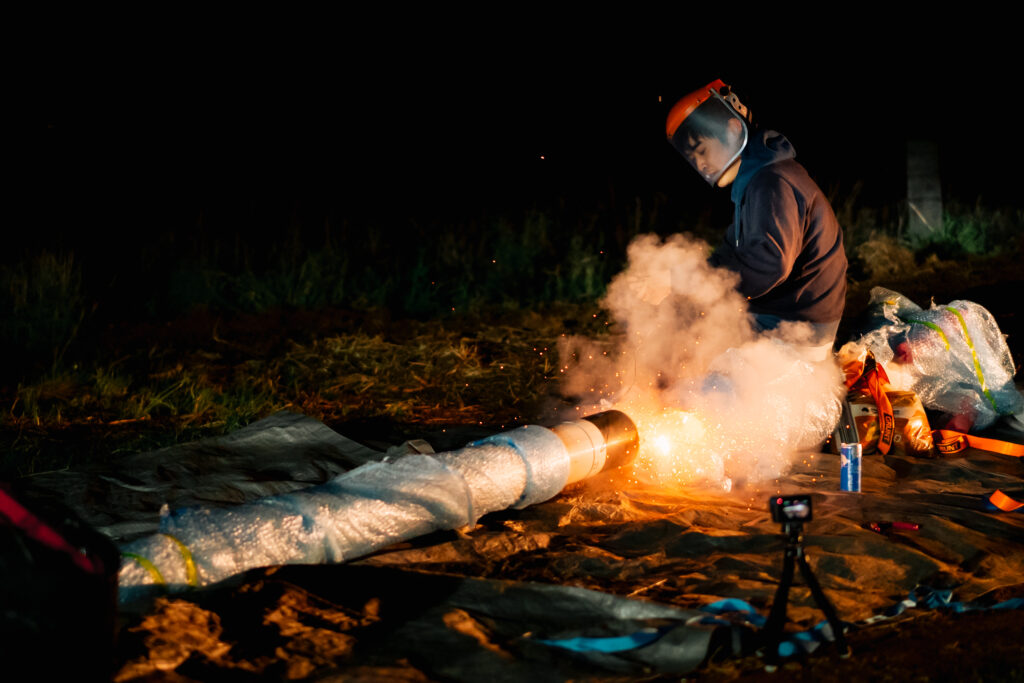
A dual separation dual deployment method has been utilised to reduce shock loading, with redundant black powder charges. Black powder quantities were determined through successful ground testing, and parachute sizes were calculated using a python script to reduce drift on descent. Hemispherical chutes were used for their high drag coefficient, which was estimated to be 1.5 based on previous experimental data and CFD simulations.